
Open letter · AI and resource use
Open letter to Google Norway
Last week I wrote an open letter to Microsoft Norway, which they have yet to find the time to answer. This week I turn to Google and its fine promises of sustainability and “net zero”, while reality reveals a brutal material truth. There is a gaping hole between your stated ambitions and the actual price that the planet – and Norway – pays for your aggressive push into artificial intelligence (AI).
While the world fights an existential climate crisis, the development of large language models and AI infrastructure demands resources that can no longer be ignored or hidden behind vague promises of carbon neutrality. The figures from your own reports are revealing too: electricity use, water use and greenhouse gas emissions are rising towards record levels as the AI race accelerates. That Google alone consumed roughly 30 billion litres of water in 2024 is not only alarming – it is massive pressure on local water resources that threatens the livelihoods of people in those communities.
The cloud
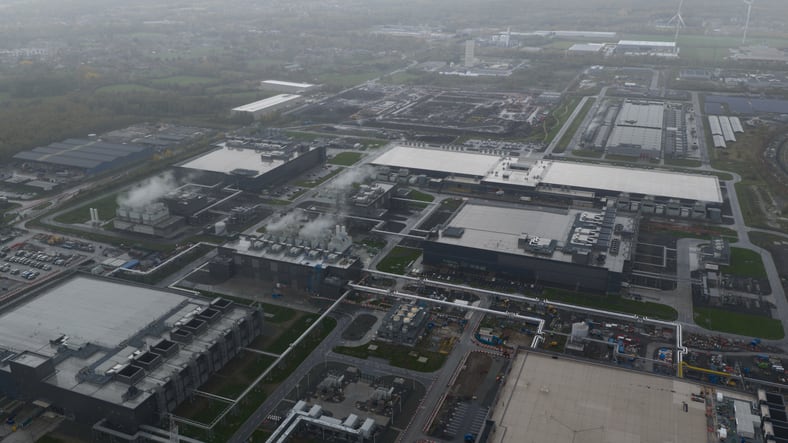
It is time to challenge the illusion of “the cloud”. The AI revolution is not virtual; it is material, destructive and resource-hungry. In 2025 the world’s data centres required about 6,900 square kilometres. None of them were in the cloud – they sit on the ground and require land, power, water and minerals. By 2030 the number of data centres is planned to double. How many square kilometres are we then talking about?
Finland
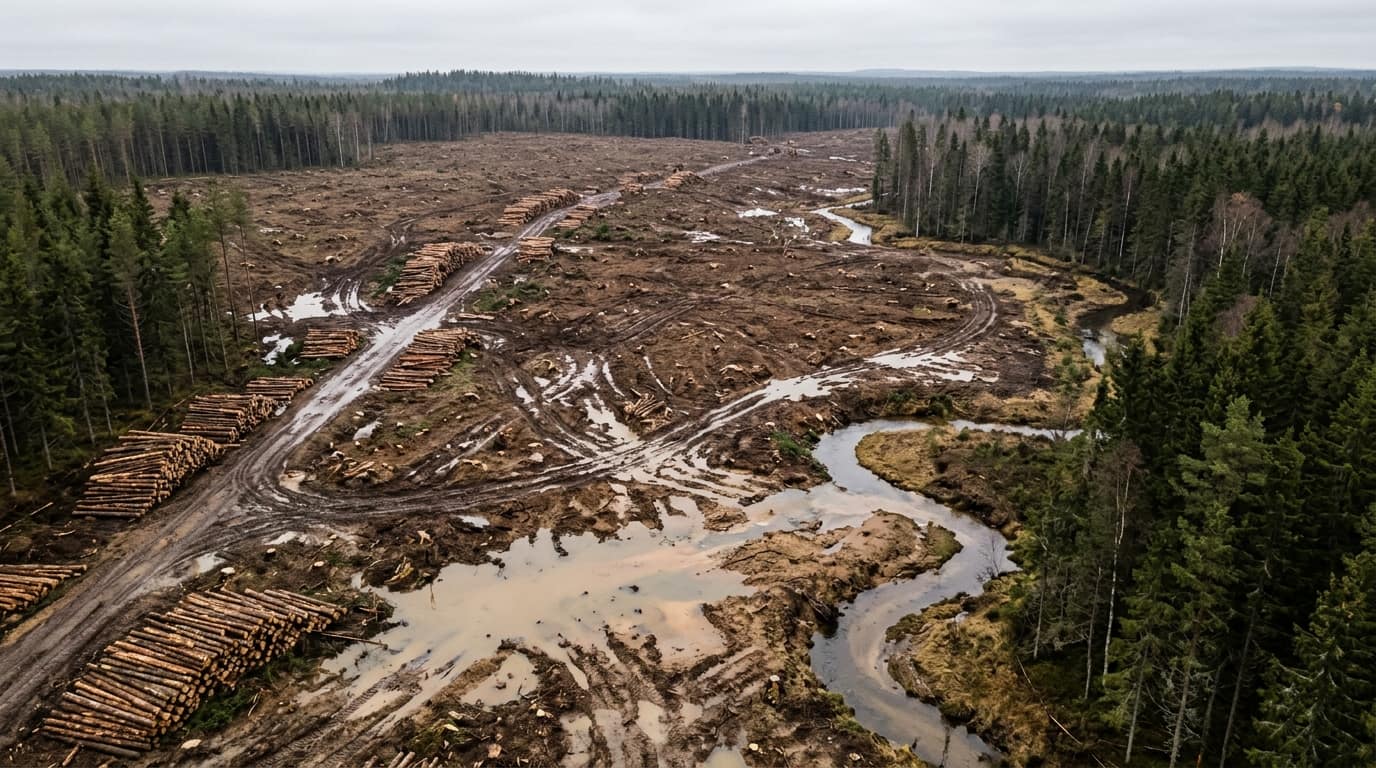
Look to Finland. Here Google’s AI ambitions have manifested as a gaping wound in the earth. In Muhos the company illegally cleared 330 hectares of forest and felled a quarter of a million trees to build a data centre. They did not just remove the forest, they stripped the topsoil itself, leaving behind a ruined landscape of mud and toxic runoff into local rivers. And that was before the necessary environmental impact assessments had been carried out. When Google later apologises by saying it acted on its “best understanding of the legislation”, that is not an excuse – it is pure arrogance. It is evidence of a corporate culture that puts speed and growth above compliance with the law and protection of nature.
The minerals
This plunder does not stop at the edge of the forest. Copper is the very nervous system of AI infrastructure, from power transmission to cooling systems. But this nervous system is built on the ruins of vulnerable ecosystems. The extraction demands enormous amounts of energy and leaves behind mountains of toxic waste and polluted groundwater. The same goes for tungsten; a necessity for withstanding the thermal pressure from AI processors, but at the price of low environmental standards and high social costs in global supply chains. Across the Global South, people pay the price for this “green” innovation.
The gas power
It also seems that Google’s strategy now runs directly against its own climate goals. To feed the enormous power demand of AI, you have begun to flirt with gas power plants. In Texas you are set to emit up to 4.5 million tonnes annually – more than the whole of San Francisco. The agreement on the Broadwing Energy Center in Illinois also shows a worrying trend: Google prioritises AI growth over actual emission cuts. Carbon capture (CCS) is used here not as a solution, but as an alibi for continuing to burn fossil fuels.
The secrecy
While you expand, you practise a culture of secrecy. In the US, non-disclosure agreements (NDAs) have been used as a weapon to hide water consumption from local residents, until the courts in Oregon and Virginia forced the truth out. The figures were, to put it mildly, alarming.
Norway
Now you are bringing this model to Norway. In Skien, Våler and Bjerkreim you are planning data centres that could take up to 10% of all Norwegian electricity. When a single player demands such a share of our national power preparedness, it is no longer a question of business development – it is a question of ethical resource management. What value are local communities and the Norwegian public left with when our natural resources are consumed on this scale?
We know the pattern from other tech giants such as Meta, and we see that in 2025 Microsoft paid as little as 2.4% tax in Norway. It is unacceptable if Google reaps the benefits of Norwegian nature and infrastructure while the financial contribution to society is vanishingly small. Politicians must dare to ask: is the environmental burden worth it?
Google Norway operates in a country that values openness, environmental protection and ethics. You can no longer hide behind global averages, American secrecy or excuses about “misunderstood legislation” in our neighbouring countries.
The demands
We therefore make the following demands of Google Norway:
- Full local transparency: Publication of detailed annual reports for every Norwegian facility, with specified water and electricity use – without aggregation.
- A guarantee against secrecy: A written commitment never to use non-disclosure agreements (NDAs) to hide environmental data from Norwegian municipalities or citizens.
- Genuinely renewable energy: A guarantee that no Norwegian data centre uses gas power, fossil energy sources or diesel generators.
- Transparent tax contribution: A public account of the effective tax rate in Norway, so that society can judge whether the return matches the use of resources.
- Ethical mineral report: A full traceability report for the copper, cobalt and tungsten used in Norwegian AI infrastructure, with documentation that the extraction does not contribute to human rights violations or irreparable environmental damage.
Technological progress cannot be justified when it comes at the expense of the planet’s carrying capacity.
Ørjan Stenseng
Founder and CEO, speaker, author
Further reading and sources
- Open letter to the leadership of Microsoft Norway – the previous letter in the series, by Ørjan Stenseng.
- Google is turning on the gas for its data centers Gas turbines generate CO2 and consume vast amounts of water
- More Oregon water for Google’s data centers – Water use in data centres for Scope 1 and 2 is staggering.
- Google’s Finnish data centre expansion sparks environmental controversy – Clears 330 decares of forest and destroys the habitat of many animals, including wolves.
- Google uses a lot of water in Oregon’s city of The Dalles. Soon we’ll know how much. – An NDA prevented insight into the consumption of natural resources.